
Ripple Oscillations May Help the Brain Coordinate Distributed Memories
New research reveals how brief bursts of high-frequency neural activity may coordinate neurons across distant regions of the human brain
Researchers from the University of California, San Diego, Cedars-Sinai Medical Center, and collaborating institutions have investigated how different regions of the human brain coordinate their activity during working memory. Using recordings from individual neurons in patients undergoing clinical monitoring for epilepsy, the researchers found that brief high-frequency oscillations called ripples were associated with increased coordination between neurons in distant brain regions. The findings provide new insight into how memories can be represented across distributed networks rather than within a single region of the brain.
Why was this study conducted?
Working memory allows the brain to temporarily store and manipulate information, such as remembering an image for a few seconds before identifying it. Although researchers know that working memory involves multiple brain regions, it remains unclear how these areas coordinate their activity to maintain the same information.
One possible mechanism is neural oscillation, in which groups of neurons exhibit rhythmic patterns of activity. Ripple oscillations, which occur at high frequencies of approximately 70–100 Hz, have been particularly associated with memory processing in the hippocampus. However, it was unclear whether ripples simply reflect increased neural activity or whether they help coordinate specific patterns of activity between distant brain regions.
To investigate this question, the researchers examined whether simultaneous ripple activity in different regions was associated with increased coordination between individual neurons.
How was the research performed?
The research team analyzed intracranial recordings from 35 patients with medically refractory epilepsy across 43 recording sessions. Because these patients had electrodes implanted for clinical monitoring, the researchers were able to record neural activity directly from the human brain at a high level of temporal and spatial resolution.
The recordings included several brain regions involved in memory and cognition, including the hippocampus, amygdala, ventromedial prefrontal cortex, anterior cingulate cortex, and pre-supplementary motor area.
Participants performed a modified Sternberg working-memory task. They were presented with either one or three images, which they had to remember during a short delay. They were then shown another image and asked whether it had appeared previously. This allowed the researchers to examine neural activity during encoding, maintenance, and retrieval.
The researchers identified individual neurons from the recordings and examined their firing patterns alongside local field potentials. Ripple events occurring simultaneously in different brain regions were classified as co-ripples. The researchers then compared neuronal coordination during co-ripples with periods when simultaneous ripples were absent.
Main findings
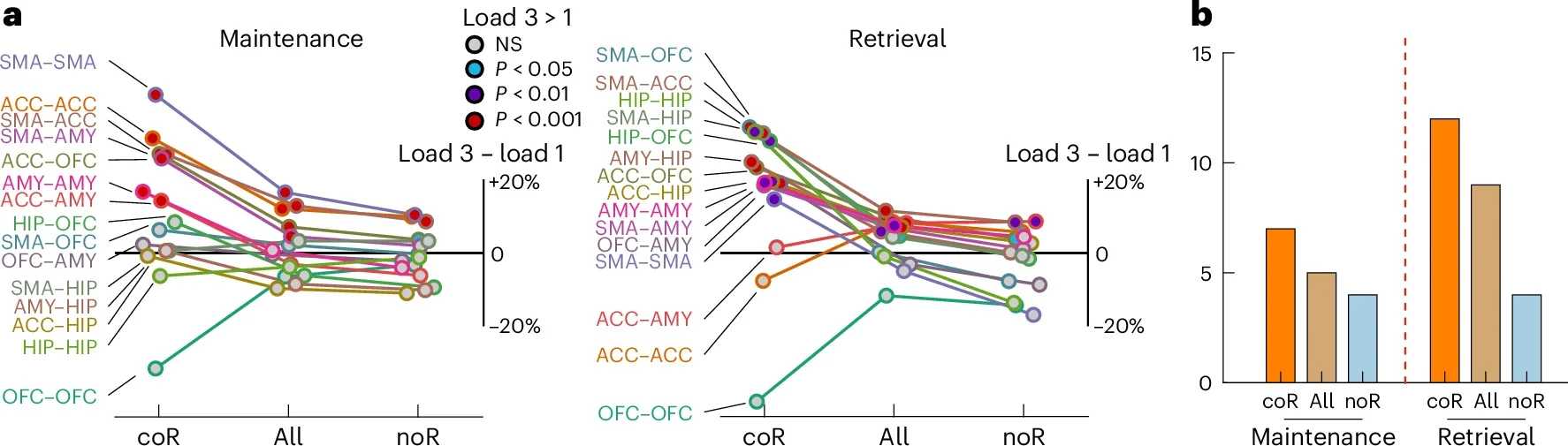
Figure 1. Co-ripple oscillations increase co-firing according to memory load.
The researchers found that simultaneous ripple activity was associated with increased co-firing, meaning that neurons in different brain regions were more likely to fire together at similar times. Cross-region neuronal co-firing increased by approximately 30% during co-ripples, even after accounting for changes in overall neuronal firing rates.
Importantly, this coordination was observed between brain regions separated by distances of up to approximately 220 millimeters. The finding suggests that ripple-associated coordination is not limited to neighboring brain regions and may help connect widely distributed neural networks.
The researchers also found that co-ripple activity increased when participants had to remember more information. When participants had to remember three images instead of one, simultaneous ripple activity became more prominent during memory maintenance and retrieval. This suggests that coordination between distant brain regions may become increasingly important as working-memory demands increase.
Finally, the researchers examined whether neural activity associated with a particular image during encoding was reproduced when the same image was later encountered during retrieval. They found that co-ripples were associated with increased reinstatement of stimulus-specific neuronal co-firing patterns, particularly during rapid and accurate memory retrieval. This suggests that ripple activity may help coordinate the reactivation of information represented across multiple brain regions.
Why are these findings important?
The findings suggest that memories may be coordinated across the brain through brief periods of synchronized neural activity. Rather than simply indicating that neurons are more active, ripple oscillations may provide temporary windows in which neurons from distant regions can coordinate their firing patterns.
This is particularly important because memories and other cognitive processes are thought to rely on distributed neural representations. Information about the same experience may be represented by neurons in multiple brain regions, meaning that effective communication between these regions is necessary for the brain to retrieve that information as a unified memory.
The study therefore provides evidence that ripple oscillations may be one mechanism through which distributed neural representations are coordinated during working memory.
However, the findings do not demonstrate that ripples directly cause memories to be transferred between brain regions. The study primarily identifies an association between co-ripples, neuronal coordination, and memory-related neural patterns. Further experiments will be necessary to determine whether manipulating ripple activity directly changes memory performance.
Limitations
Several limitations should be considered when interpreting the findings. First, the recordings were obtained from patients with medically refractory epilepsy who had intracranial electrodes implanted for clinical purposes. Neural activity in these patients may differ from that of healthy individuals, and the locations of the electrodes were determined by clinical requirements rather than solely by the needs of the experiment.
Second, although the study provides evidence that co-ripples are associated with increased coordination and memory-related neural patterns, it does not establish a direct causal relationship. Future studies could investigate whether artificially increasing or suppressing ripple activity changes working-memory performance.
Further research may also determine whether similar ripple-mediated coordination occurs during other forms of memory and cognition, and whether disruptions in this mechanism contribute to neurological disorders.
References
Verzhbinsky, I. A., Daume, J., Cheng, S., Rutishauser, U., & Halgren, E. (2026). Cross-region neuron co-firing mediated by ripple oscillations supports distributed working memory representations. Nature Neuroscience. https://doi.org/10.1038/s41593-026-02403-z